Contents — explore this biography
Mary Anne Evans and an intellectual educationTranslation, criticism and the Westminster ReviewThe emergence of a novelistMiddlemarch and the limits of individual visionLater work and the reach of literary sympathyMary Anne Evans and an intellectual education
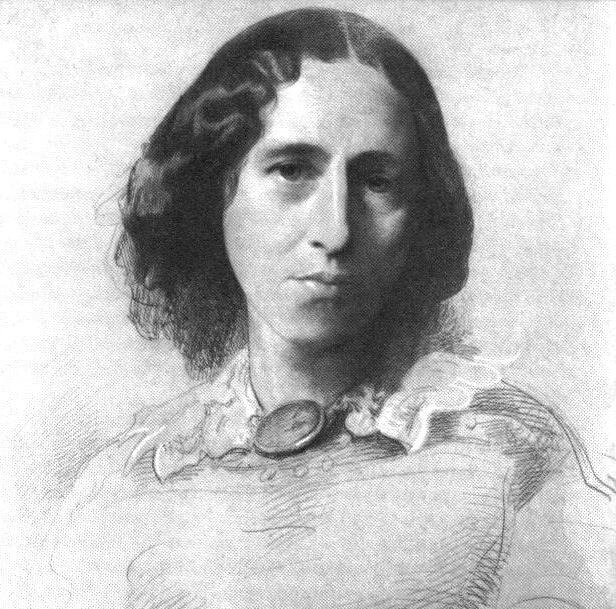
George Eliot was born Mary Anne Evans in Warwickshire in 1819. Her education combined formal schooling with extensive independent reading, including access to the library at Arbury Hall, where her father managed the estate. Languages, theology and European philosophy became lasting interests. Her development cannot be separated from the changing religious and intellectual arguments of nineteenth-century Britain. She moved from youthful religious commitment toward an independent examination of belief, while retaining a serious interest in moral obligation. The questions later dramatized in her novels grew from this prolonged engagement with ideas and ordinary social experience.
Translation, criticism and the Westminster Review
Before becoming a celebrated novelist, Eliot translated German scholarship and established herself as an editor and critic. Her translation of David Friedrich Strauss’s Life of Jesus appeared in 1846. In the early 1850s she became closely involved in editing the Westminster Review, writing about literature, religion, science and philosophy. This work placed her within a European intellectual conversation and a demanding periodical culture. It also gave her experience of weighing arguments, explaining unfamiliar ideas and observing how moral convictions can become attached to professional identities. Her later fiction extended that intellectual activity through imagined lives and relationships.
The emergence of a novelist
The name George Eliot appeared with her fiction in 1857, and Adam Bede followed in 1859. The pseudonym created distance between the published work and the public circumstances of its author. Her long partnership with George Henry Lewes, who was married and unable to divorce, had exposed her to social disapproval. The Mill on the Floss and Silas Marner developed her reputation through very different narrative scales. Across these books, memory, family obligation and community judgment are active forces. Characters do not simply choose among abstract moral principles; they act within histories that shape what they can recognize as possible.
Middlemarch and the limits of individual vision
Middlemarch appeared in parts in 1871–1872, linking ambitions for reform with marriage, medicine, money, inheritance and provincial politics. Its connected stories make it difficult to assign every consequence to a single person’s intention. Dorothea Brooke and Tertius Lydgate imagine useful lives, but their projects enter institutions and relationships whose pressures they only partly understand. Eliot’s narration enlarges the reader’s field of attention, moving between perspectives and exposing the incompleteness of each. The novel’s ethical force lies partly in this discipline of looking again: a life that seems small from one vantage can contain substantial difficulty, longing and effort.
Later work and the reach of literary sympathy
Eliot continued to experiment with form through poetry, essays and fiction, including Daniel Deronda in 1876. After Lewes’s death in 1878, she married John Walter Cross in 1880 and died later that year. Her continuing influence rests on more than the prestige of Victorian realism. She made the work of understanding others central to literary form, while showing that sympathy does not remove conflict or guarantee correct decisions. The novels ask what people owe to lives beyond their immediate interests. Their communities remain persuasive because generous impulses, self-deception and material dependence coexist within the same people.
Career timeline
Born Mary Anne Evans in Warwickshire.
Her translation of Strauss’s Life of Jesus was published.
Adam Bede established her reputation as a novelist.
Middlemarch appeared in parts.
Married John Walter Cross and died later in the year.
Selected works & milestones
Adam Bede
Her first full-length published novel.
The Mill on the Floss
A novel of family, memory and constrained choices.
Silas Marner
A study of isolation, community and renewed attachment.
Middlemarch
Interconnected lives within an English provincial community.
- Stanford Encyclopedia of Philosophy — George Eliot
- English Heritage — George Eliot
- Academy of American Poets — George Eliot
Published 2026-11-07. Sources reviewed for this edition. Independent coverage of public professional activity.