Contents — explore this biography
An education directed toward the cosmosReading the environments of other planetsCosmos and the public imaginationBooks, institutions and scientific citizenshipA legacy of curiosity and scrutinyAn education directed toward the cosmos
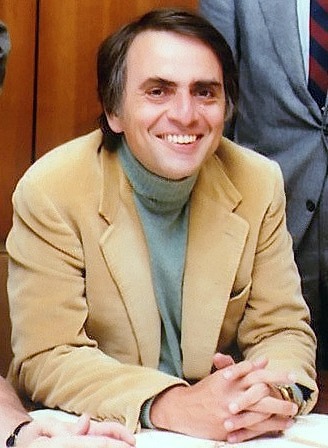
Carl Sagan was born in Brooklyn in 1934 and developed an early fascination with stars and the possibility of other worlds. His university education at Chicago brought physics, astronomy and astrophysics into a single intellectual formation, culminating in a doctorate in 1960. After teaching and research at Harvard, he joined Cornell in 1968. Cornell became his long-term academic home, where he directed the Laboratory for Planetary Studies and taught students as well as conducting research. His later public prominence grew from this sustained scientific career rather than replacing it.
Reading the environments of other planets
Sagan investigated how physical processes could explain worlds that appeared unfamiliar from Earth. His research addressed Venus’s high surface temperature through a strong greenhouse effect, the changing appearance of Mars through windblown dust, and the chemistry behind Titan’s atmospheric haze. These studies linked observations to testable explanations instead of treating planetary exploration as a catalogue of surprising images. His participation in American space missions, including Mariner, Viking, Voyager and Galileo, connected theoretical interpretation with the instruments and questions carried aboard spacecraft. The possibility of extraterrestrial life remained a scientific question, not an established discovery.
Cosmos and the public imagination
The television series Cosmos, first broadcast in 1980, presented astronomy alongside the history of ideas, the development of life and the tools of scientific reasoning. Sagan’s role as presenter made him recognizable internationally, while the accompanying book extended the programme’s reach. Its ambition was to make difficult subjects intelligible without removing their scale or uncertainty. He treated the audience as capable of following arguments about evidence, time and cosmic distance. That approach helped establish an influential model of science communication in which explanation and emotional engagement could reinforce one another.
Books, institutions and scientific citizenship
Sagan wrote across several forms, including the Pulitzer-winning The Dragons of Eden, the novel Contact and Pale Blue Dot. The movement between research, speculation and narrative was central to his public work, although the forms required different standards of evidence. In 1980 he co-founded The Planetary Society with Bruce Murray and Louis Friedman, creating an organization through which members of the public could support exploration. He also examined the environmental consequences of nuclear war. These activities made the relationship between scientific knowledge and collective choices a recurring theme of his career.
A legacy of curiosity and scrutiny
Sagan died in 1996 after illness, leaving a body of scientific research and public writing that continued to circulate widely. His influence is visible in generations of researchers and communicators drawn toward astronomy by his work. It is also found in the expectation that public claims should be examined carefully, particularly when they invite belief through authority or excitement alone. His career joined imaginative questions with the practical need to distinguish observation from conjecture. The enduring value of that combination lies in an invitation to investigate, rather than a demand to accept any scientist as infallible.
Career timeline
Born in Brooklyn, New York.
Completed his doctorate at the University of Chicago.
Joined Cornell University.
Cosmos premiered and The Planetary Society was founded.
Died in Seattle on December 20.
Selected works & milestones
The Dragons of Eden
A book on the evolution of intelligence; awarded the 1978 Pulitzer Prize.
Cosmos
Television series and accompanying book on science and humanity’s place in the universe.
The Planetary Society
Co-founded with Bruce Murray and Louis Friedman.
Pale Blue Dot
Reflections on Earth and the future of space exploration.
- Cornell University — obituary and scientific career
- NASA — planetary research and missions
- SETI Institute — Carl Sagan
- Cornell University — books and public legacy
- Pulitzer Prizes — 1978 award
Published 2026-11-05. Sources reviewed for this edition. Independent coverage of public professional activity.