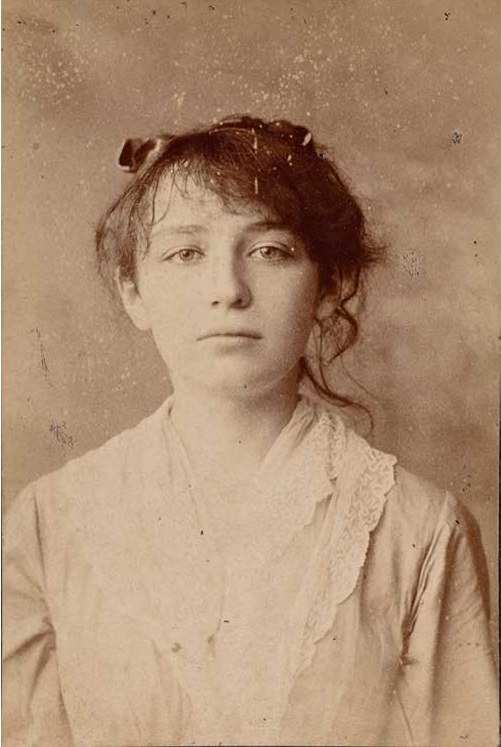
Contents — explore this biography
An early commitment to sculptureCollaboration and an independent identityBodies held in movementNew subjects and demanding materialsInterrupted work and later recognitionAn early commitment to sculpture
Camille Claudel was born in Fère-en-Tardenois in 1864 and began modelling clay while young. The sculptor Alfred Boucher recognized her ability and encouraged her development. Moving to Paris gave her access to training and a community of aspiring artists at a time when women faced serious barriers within official art education. Sculpture also demanded resources for materials, studio space and production. Her decision to pursue it required sustained practical commitment as well as artistic confidence and an unusual determination to work professionally.
Collaboration and an independent identity
Claudel entered Auguste Rodin’s working circle during the 1880s and contributed to the activity of his studio. Their personal and professional relationship was important, but it does not provide a complete explanation of her art. Both artists studied the expressive possibilities of bodies in contact and in motion. Claudel developed her own compositions and exhibited independently, while comparisons with Rodin complicated her reception. Assessing her work means examining its form, subject and material rather than treating it as supporting evidence in another artist’s biography.
Bodies held in movement
The Waltz presents a couple joined in a turning movement that seems to continue beyond the sculpture’s fixed material. Drapery both conceals and amplifies the figures, connecting physical balance with emotional intensity. Other works, including Sakuntala, explore relationships through the inclination of a head, the pressure of an embrace and the unstable distribution of weight. These compositions show how modelling can direct attention through a group, making a gesture readable from several viewpoints without reducing the figures to a single theatrical pose.
New subjects and demanding materials
In the 1890s Claudel increasingly explored subjects and formats that asserted her independence. Small groups such as The Gossips bring concentrated human interaction into an intimate setting. The Wave combines figures with a dramatically rising natural form, while contrasting materials extend the visual and tactile experience. She worked through different versions, scales and casts, negotiating the practical problems of finding patrons and securing commissions. This experimentation places her within broader discussions about decorative art, modern sculpture and the expressive use of space.
Interrupted work and later recognition
Claudel’s working life deteriorated in the early twentieth century, and her family arranged her admission to a psychiatric institution in 1913. She remained institutionalized until her death in 1943. That history is essential, but it should not overshadow the substantial body of work she had already made. Later exhibitions and scholarship restored attention to her achievements, including a retrospective at the Musée Rodin in 1951. Her sculptures now support a fuller account of artistic exchange, professional obstacles and individual invention in modern French art.
Career timeline
Born in Fère-en-Tardenois.
Moved to Paris to pursue artistic training.
Presented The Waltz at the Salon National des Beaux-Arts.
Entered institutional care, ending her active sculptural career.
Died at Montdevergues.
Selected works & milestones
Sakuntala
A sculptural group inspired by a literary encounter and developed in later versions.
The Waltz
A major exhibited composition of a couple in turning movement.
The Wave
Figures placed beneath a rising wave, with contrasting materials.
The Age of Maturity
A group exploring separation, attachment and the passage of life.
- Musée Camille Claudel — biography
- Musée Rodin — Camille Claudel
- Getty — Camille Claudel exhibition
- Musée Rodin — The Waltz
Published 2026-11-05. Sources reviewed for this edition. Independent coverage of public professional activity.