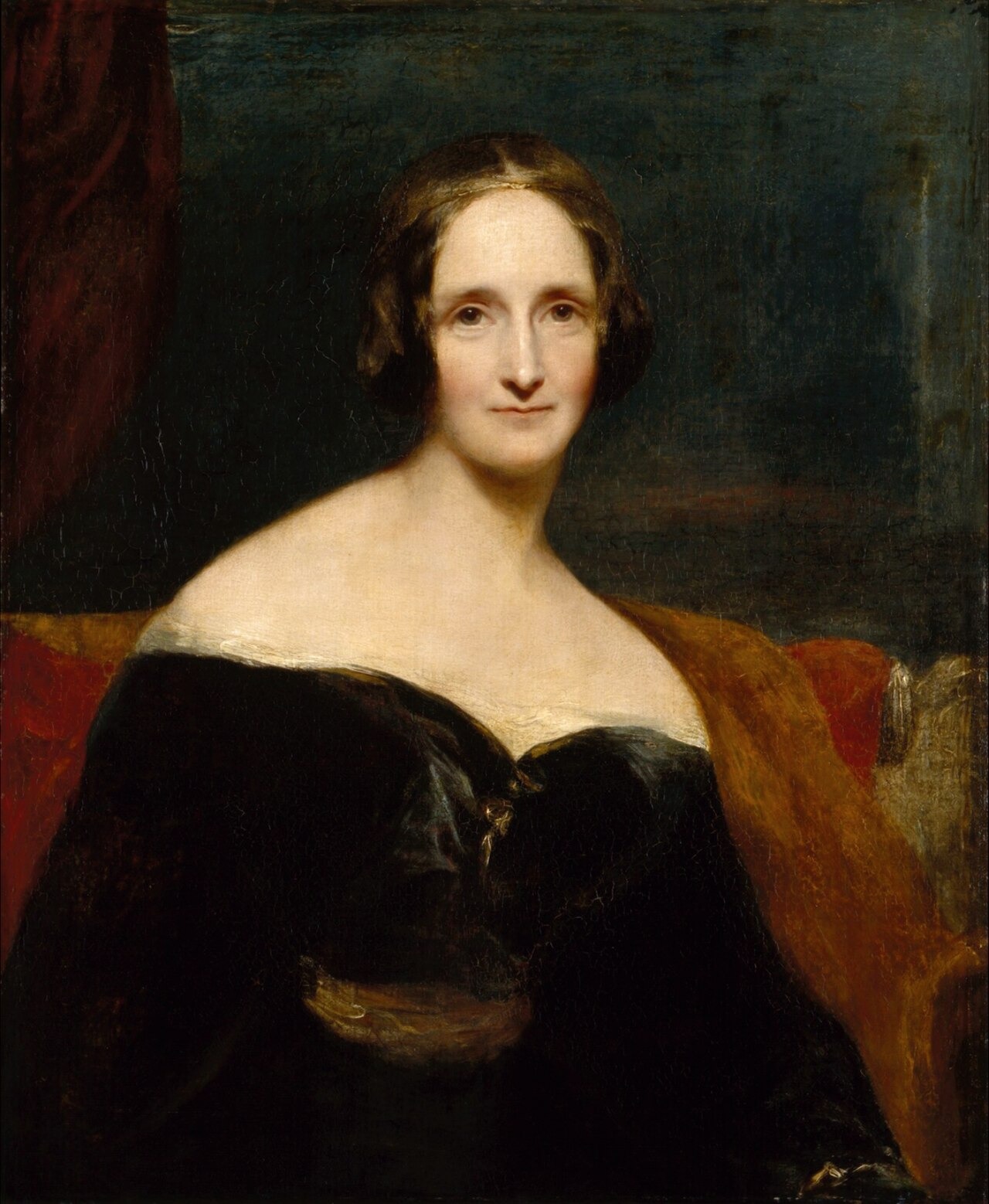
Contents — explore this biography
A childhood surrounded by radical ideasGeneva and the beginning of FrankensteinCreation, rejection and responsibilityA career beyond a single novelEditorial work and a continuing legacyA childhood surrounded by radical ideas
Mary Shelley was born Mary Wollstonecraft Godwin in London in 1797. Her mother, the feminist writer Mary Wollstonecraft, died shortly after her birth; her father was the philosopher and novelist William Godwin. Books and visiting writers made the household an unusually rich intellectual environment. Her education extended through extensive reading rather than following a conventional school career. These circumstances placed questions about reason, social authority and the position of women close to her earliest experience. They also supplied an inheritance she would reconsider through fiction rather than simply reproduce as a set of arguments.
Geneva and the beginning of Frankenstein
In 1814 Mary left England with the poet Percy Bysshe Shelley, whom she married in 1816. During that year’s stay near Lake Geneva, the company around Lord Byron proposed writing ghost stories. Mary began the project that became Frankenstein; or, The Modern Prometheus. The surviving manuscript notebooks reveal sustained composition and revision, with annotations by Percy alongside her own writing. The novel therefore belongs both to a dramatic episode in literary biography and to the ordinary labour of developing a manuscript. Its achievement cannot be reduced to the familiar image of a single extraordinary dream.
Creation, rejection and responsibility
Frankenstein appeared anonymously in 1818. Its multiple narrators make the reader compare accounts rather than accept one secure explanation. Victor Frankenstein’s scientific ambition leads to the creation of a living being, but the ethical problem continues after the experiment succeeds. The creature’s experiences of language, exclusion and longing ask what a creator owes to a dependent life. Shelley revised the novel for the 1831 edition and supplied a new introduction. Reading the different versions helps distinguish her published text from later theatrical and cinematic images that often changed the creature’s character and capacities.
A career beyond a single novel
Shelley’s other books show a broader range than her reputation as the author of Frankenstein sometimes suggests. Valperga, published in 1823, uses historical romance to examine power and loyalty in medieval Italy. The Last Man, published in 1826, imagines a future world devastated by plague. Its scale shifts from individual relationships and political hopes to the survival of human society itself. She also wrote travel narratives, stories, essays and biographies. The variety matters because it reveals an author working across literary markets and forms, while repeatedly returning to questions about loss, belonging and the consequences of political ambition.
Editorial work and a continuing legacy
After Percy Shelley’s death in 1822, Mary returned to England and continued writing while raising their surviving son. Her editorial work helped shape the reception of Percy’s poetry, giving her a consequential place in the preservation of Romantic literature as well as its creation. She died in 1851. The long afterlife of Frankenstein reaches into debates about scientific responsibility, technology and the making of persons. Those later applications are interpretations rather than predictions she explicitly supplied. Her literary importance rests on narratives that keep competing claims alive, asking readers to confront obligations that ambition alone cannot settle.
Career timeline
Born in London to Mary Wollstonecraft and William Godwin.
Began Frankenstein during the summer near Lake Geneva.
Frankenstein was first published anonymously.
The Last Man was published.
Died after a career in fiction, biography, travel writing and editing.
Selected works & milestones
Frankenstein; or, The Modern Prometheus
A novel of creation, rejection and responsibility; revised in 1831.
Valperga
Historical fiction set in medieval Italy.
The Last Man
A future narrative of plague and human survival.
Rambles in Germany and Italy
A work of travel writing.
- University of Oxford — Frankenstein
- The Shelley-Godwin Archive — Frankenstein manuscripts
- National Library of Medicine — the birth of Frankenstein
- The Open University — Mary Shelley’s life and writing
Published 2026-11-07. Sources reviewed for this edition. Independent coverage of public professional activity.