Contents — explore this biography
Cambridge, government and public argumentThe consequences of war and peaceDemand, investment and persistent unemploymentBretton Woods and international institutionsAn influential and contested intellectual inheritanceCambridge, government and public argument
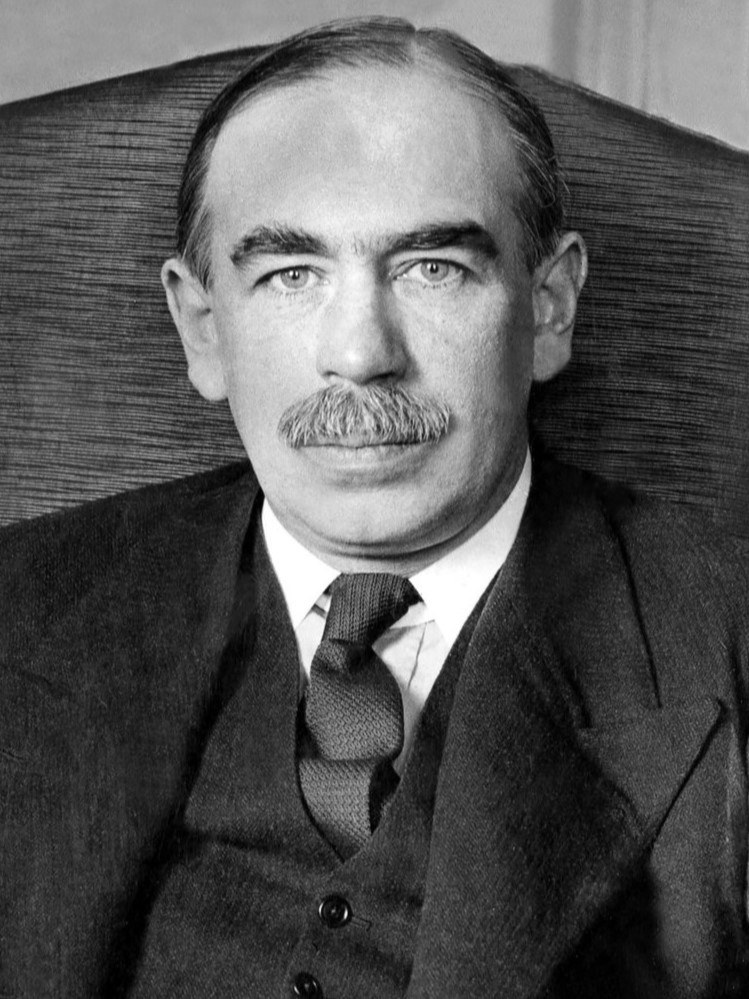
John Maynard Keynes was born in Cambridge in 1883 and studied at Eton and King’s College. After a period at the India Office, he returned to academic life and became a fellow of King’s. His career combined research, editorial work, public administration and practical involvement in finance. He was also connected with the Bloomsbury circle and cultural institutions. These overlapping activities matter because his economic writing addressed immediate public problems while drawing on a much broader interest in uncertainty, judgment and the conditions of a civilized society.
The consequences of war and peace
Keynes worked on wartime finance and attended the Paris Peace Conference as a British Treasury representative. He resigned and published The Economic Consequences of the Peace in 1919, criticizing the settlement’s economic assumptions and its implications for European recovery. The book made him an internationally prominent public intellectual. Its significance lies not simply in individual forecasts, but in its insistence that political agreements must be examined through their effects on production, trade, obligations and the capacity of societies to rebuild.
Demand, investment and persistent unemployment
The General Theory of Employment, Interest and Money, published in 1936, challenged the expectation that an economy would reliably return to full employment through ordinary market adjustment. Keynes emphasized aggregate demand, investment expectations and the possibility that uncertainty could discourage spending. His argument gave governments a stronger rationale for stabilizing economic activity during downturns. It did not mean that every increase in spending was desirable under every condition; the relationship between resources, employment, prices and confidence remained central to the problem he was trying to explain.
Bretton Woods and international institutions
During the Second World War, Keynes helped develop proposals for a postwar monetary order and led the British delegation at Bretton Woods in 1944. His ideas differed in important respects from those of the American delegation led intellectually by Harry Dexter White. The final arrangements reflected negotiation and unequal economic circumstances, rather than the adoption of one economist’s complete blueprint. The International Monetary Fund and World Bank emerged from this process, linking financial cooperation with the wider aims of reconstruction and stability.
An influential and contested intellectual inheritance
Keynes died in 1946, leaving a body of work that reshaped economics and policy after the war. Later economists developed several distinct forms of Keynesian analysis, so his name does not denote a single unchanging policy programme. Disagreements over inflation, expectations, public debt and the effectiveness of intervention remain part of that inheritance. His enduring contribution was to make the coordination of spending, investment and employment a central subject of economic inquiry, and to insist that prolonged unemployment required explanation rather than acceptance as an automatic equilibrium.
Career timeline
Born in Cambridge, England.
Became a fellow of King’s College, Cambridge.
Published The Economic Consequences of the Peace.
Published The General Theory of Employment, Interest and Money.
Led the British delegation at Bretton Woods.
Selected works & milestones
The Economic Consequences of the Peace
An influential critique of the postwar settlement.
A Treatise on Money
An investigation of monetary relationships and economic fluctuations.
The General Theory
A foundational work on employment, interest and aggregate demand.
Bretton Woods negotiations
Helped shape the debate over postwar monetary institutions.
- King’s College Cambridge — biography
- IMF — Keynesian economics
- Federal Reserve History — Bretton Woods
- IMF — institutional origins
Published 2026-11-05. Sources reviewed for this edition. Independent coverage of public professional activity.