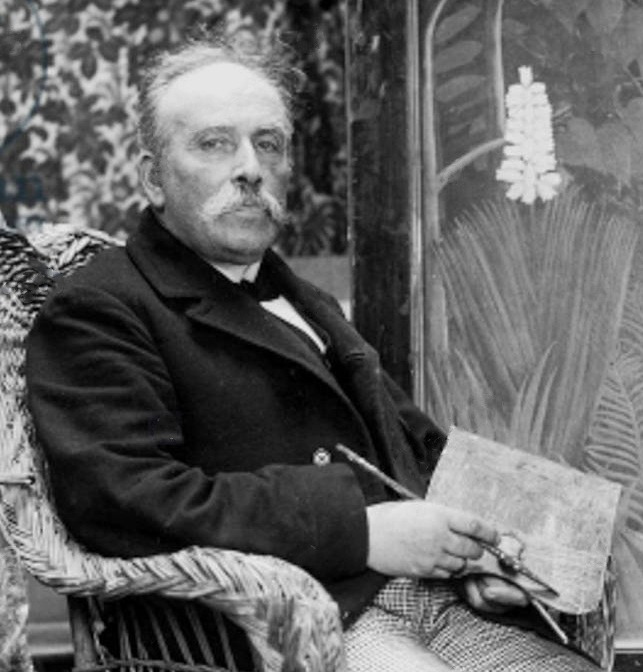
Contents — explore this biography
Laval, working life and the route into paintingExhibiting without adopting academic expectationsImagined jungles and a constructed natural worldThe Sleeping Gypsy, portraits and late recognitionThe Dream and a modern legacy beyond labelsLaval, working life and the route into painting
Henri Rousseau was born in Laval in 1844 and developed his artistic career outside the usual sequence of academy training and professional apprenticeship. He worked in the Paris municipal toll service, a position that led to the enduring nickname Le Douanier. Although commonly translated as customs officer, the title can obscure the more specific nature of that employment. He painted alongside his ordinary working life and later devoted more time to art after retiring in 1893. This background matters because the distinction between professional training and serious artistic intention became a central issue in the reception of his work.
Exhibiting without adopting academic expectations
From 1886 Rousseau exhibited at the Salon des Indépendants, a setting that provided opportunities outside the established jury system. His pictures often attracted ridicule because their scale, perspective and treatment of figures did not follow accepted academic conventions. Yet the paintings were not casual jokes. He worked with care and ambition, looking at established art while pursuing methods that remained his own. The label self-taught describes an educational situation, but it does not explain the pictures by itself. Their unusual organization can be studied as a set of deliberate visual choices rather than dismissed as an inability to imitate academic technique.
Imagined jungles and a constructed natural world
Rousseau’s best-known jungle scenes emerged from imagination and sources available in France, including botanical gardens, popular imagery and the study of plants. They should not be treated as eyewitness reports of tropical travel. Surprised!, painted in 1891, places a tiger within a compressed and agitated world of foliage and weather. Leaves are described individually while the overall space remains difficult to measure. The combination produces an environment that feels simultaneously meticulous and impossible. This tension helps explain why later artists found the work compelling: convincing detail can intensify a fantasy rather than turn it into ordinary naturalistic description.
The Sleeping Gypsy, portraits and late recognition
The Sleeping Gypsy of 1897 demonstrates another form of Rousseau’s controlled strangeness. A figure, a lion and a sparse nocturnal landscape occupy a scene whose stillness invites questions without providing a clear story. His portraits and city views similarly organize familiar subjects through unexpected proportions and sharply defined forms. Admirers among the Paris avant-garde, including Picasso and the poet Apollinaire, helped change the social setting in which his work was discussed. Their interest did not erase his financial difficulties or make recognition universal. It did establish that artistic importance could emerge from practices that sophisticated viewers had initially dismissed.
The Dream and a modern legacy beyond labels
Rousseau painted The Dream in 1910, the year of his death. Its improbable meeting of a reclining figure, domestic furniture and lush vegetation brings together many of his recurring concerns. The picture does not need to obey a plausible physical setting in order to sustain a coherent imaginative world. Later modernists and Surrealists valued this capacity to make ordinary distinctions uncertain. Terms such as naive and primitive have often accompanied his reputation, but they can also carry assumptions about knowledge and cultural hierarchy. His legacy is more usefully approached through the paintings themselves: their intricate surfaces, emphatic arrangements and persistent refusal to explain away their own mystery.
Career timeline
Born in Laval, France.
Began exhibiting at the Salon des Indépendants.
Retired from the municipal toll service to focus on painting.
Painted The Sleeping Gypsy.
Painted The Dream and died in Paris.
Selected works & milestones
Surprised!
An early jungle painting featuring a tiger in a storm.
The Sleeping Gypsy
A nocturnal scene with a resting figure and a lion.
Portrait of Joseph Brummer
A portrait of the art dealer and supporter.
The Dream
A major late jungle composition.
- National Gallery, London — Henri Rousseau
- Guggenheim — Henri Rousseau
- MoMA — Henri Rousseau
- MoMA — The Dream
Published 2026-11-09. Sources reviewed for this edition. Independent coverage of public professional activity.