Contents — explore this biography
From Zanzibar to an artistic education in LondonQueen and the development of a collaborative soundSongwriting beyond the conventional singleLive Aid, solo recordings and BarcelonaFinal recordings and a continuing public legacyFrom Zanzibar to an artistic education in London
Freddie Mercury was born Farrokh Bulsara in Zanzibar in 1946. Much of his childhood was spent in India, where school and piano lessons formed part of his early musical education. His family moved to England in 1964, and he later studied graphic design at Ealing College of Art. The combination of musical practice and visual training is relevant to his later work: a performance could be conceived through costume, gesture, staging and graphic identity as well as through sound. Several early bands preceded the collaboration that would make his voice familiar around the world.
Queen and the development of a collaborative sound
Queen formed in 1970 around Mercury, guitarist Brian May and drummer Roger Taylor; bassist John Deacon joined in 1971. Their debut album appeared in 1973, beginning a recording career in which all four members contributed to the group’s identity. Mercury’s singing and compositions were central, but the music also depended on May’s guitar sound, the rhythm section and a shared willingness to make studio arrangements elaborate. The resulting records moved between heavy rock, melodic pop and theatrical invention. This range gave Mercury room to alternate tenderness, irony, force and extravagant display within a recognizable musical setting.
Songwriting beyond the conventional single
Bohemian Rhapsody, released in 1975 on A Night at the Opera, became a defining demonstration of Mercury’s approach to musical structure. Its contrasting passages make a single recording behave like a sequence of dramatic scenes, with changes in texture shaping the listener’s expectations. Other songs, including Killer Queen and We Are the Champions, reveal different uses of character and collective emotion. The significance of this work is not only the size of its audience. Mercury helped make intricate vocal layering and abrupt stylistic shifts part of the vocabulary of mainstream rock recording, without giving up direct melodic appeal.
Live Aid, solo recordings and Barcelona
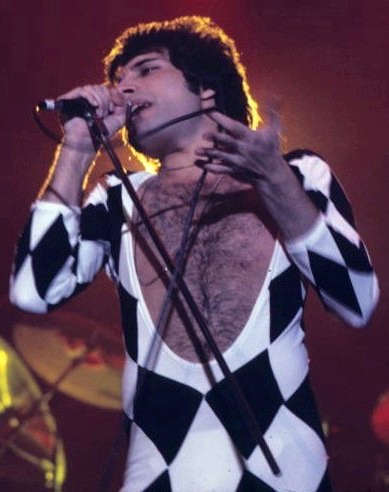
Mercury’s command of large audiences became especially visible during Queen’s appearance at Live Aid at Wembley Stadium in July 1985. In a short set, he used familiar songs, movement and audience participation to create a strong sense of shared occasion. His work outside Queen explored other possibilities. Mr. Bad Guy appeared in 1985, while the Barcelona project with soprano Montserrat Caballé brought his fascination with opera into an explicit recording partnership. Released in 1988, that album was a collaboration between contrasting vocal traditions. It shows an artist interested in the expressive possibilities of encountering another musical discipline.
Final recordings and a continuing public legacy
Mercury continued recording with Queen during his final years, including work released on Innuendo in 1991. He died on November 24 that year following illness from AIDS. The 1992 Freddie Mercury Tribute Concert and the establishment of the Mercury Phoenix Trust connected remembrance with efforts to address HIV and AIDS. Queen entered the Rock & Roll Hall of Fame in 2001. His legacy includes songs, recorded performances and a theatrical model of frontmanship, but it also requires attention to the distinction between the public performer and a private life that cannot be reduced to stage mythology.
Career timeline
Born Farrokh Bulsara in Zanzibar.
Queen formed in London.
Bohemian Rhapsody appeared on A Night at the Opera.
Performed with Queen at Live Aid and released Mr. Bad Guy.
Died in London on November 24.
Selected works & milestones
Killer Queen
A Mercury composition released on Sheer Heart Attack.
Bohemian Rhapsody
A multi-section song from A Night at the Opera.
Mr. Bad Guy
His first solo studio album.
Barcelona
A collaborative album with Montserrat Caballé.
- Freddie Mercury — official biography
- Queen — Freddie Mercury biography
- Queen — band history
- Rock & Roll Hall of Fame — Queen
Published 2026-11-07. Sources reviewed for this edition. Independent coverage of public professional activity.