Contents — explore this biography
Villa Fiorito and an early professional breakthroughArgentina and the defining tournament of 1986Napoli and the transformation of a clubAnother final, later clubs and coachingDeath and the interpretation of a sporting iconVilla Fiorito and an early professional breakthrough
Diego Armando Maradona was born in Lanús in 1960 and grew up in Villa Fiorito, on the outskirts of Buenos Aires. His early football developed in an environment where improvisation, close control and competitive street games mattered. He made his first-team debut for Argentinos Juniors in 1976, before his sixteenth birthday, and soon attracted attention beyond Argentina. A move to Boca Juniors brought a domestic championship in 1981, followed by a transfer to Barcelona in 1982. The rapid progression placed an unusually gifted young player inside institutions whose expectations extended far beyond his performances.
Argentina and the defining tournament of 1986
Maradona’s central place in football history rests especially on the 1986 World Cup in Mexico, where he captained Argentina to the title and received the tournament’s Golden Ball. Against England in the quarter-final, his two goals compressed opposite aspects of his reputation into one match: an illegally handled opening goal and a remarkable run through the opposition for the second. Treating the episode as a simple legend misses the distinction between them. Across the tournament, his dribbling, passing and capacity to draw defenders also created opportunities for teammates rather than merely producing individual highlights.
Napoli and the transformation of a club
After Barcelona, Maradona joined Napoli in 1984. His years in southern Italy produced two Serie A championships, in 1987 and 1990, and the UEFA Cup in 1989. These achievements carried social meaning because Napoli represented a city accustomed to comparisons with the wealthier clubs of northern Italy. Maradona became a focus of civic pride, although the victories depended on a team, coaching and organization as well as its most celebrated player. His technical influence could be seen in the way a change of direction or a disguised pass altered the shape of an entire attack.
Another final, later clubs and coaching
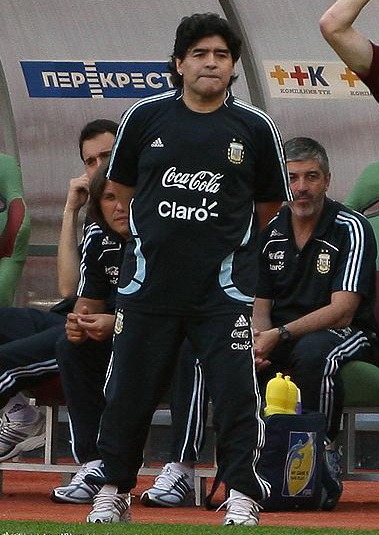
Maradona led Argentina to a second consecutive World Cup final in 1990, when West Germany won the deciding match. His later playing career included Sevilla, Newell’s Old Boys and a return to Boca Juniors. The years after his peak were complicated by health difficulties and disciplinary controversies, challenging any attempt to describe his life as a continuous ascent. He subsequently worked as a coach, including leading Argentina at the 2010 World Cup. Coaching required a different kind of authority from playing: transmitting ideas and managing a group could not simply reproduce the instincts that had made him exceptional with the ball.
Death and the interpretation of a sporting icon
Maradona died on November 25, 2020. His memory is sustained through recordings, exhibitions, murals and the continued attachment of supporters in Argentina and Naples. The image of the number ten remains associated with creativity under pressure, a low centre of gravity and the ability to retain possession in crowded spaces. A considered biography also separates sporting influence from unquestioning admiration. His career illustrates how technical brilliance, public expectation and personal vulnerability can coexist, and why an athlete’s cultural importance may become larger and more contradictory than the list of trophies that initially established it.
Career timeline
Born in Lanús, Argentina.
Made his first-team debut for Argentinos Juniors.
Joined Napoli after playing for Barcelona.
Captained Argentina to the World Cup title.
Died on November 25.
Selected works & milestones
FIFA World Cup
Captained the winning Argentina team and received the Golden Ball.
First Napoli Serie A title
Helped Napoli win its first Italian league championship.
UEFA Cup
A major European trophy with Napoli.
World Cup final and second Scudetto
Reached another international final and won another Italian league title.
- FIFA — career remembrance
- Argentine Football Association — Maradona remembrance
- FIFA — four World Cup appearances
- CONMEBOL Copa América — sporting legacy
Published 2026-11-07. Sources reviewed for this edition. Independent coverage of public professional activity.